

Joining nonwovens using ultrasonics
Nonwovens consist of individual fibers or endless filaments (fibers of unlimited length) which form a loose cohesion.Nonwovens with thermoplastic parts (plastics which are shaped when heat is applied) can be welded using ultrasonics. Here, the plastic part of the material is heated by ultrasonics, melted and the nonwovens can be connected together (welded) without adhesive.
What is that suitable for?
Joining nonwovens without additives is perfect for hygiene products, medical engineering and cosmetics and healthcare products. Ultrasonic welding is used to:
· Laminate various layers together (e.g. for diapers)
· Incorporate embossing structures (e.g. for cotton pads)
· Separate and hemming of edge areas
· Perforate web material
Welding / cross seal
Nonwovens can also be welded with a cross seal. As with the longitudinal seal, the sonotrode works in a fixed position without upward or downward movements.. The rotary anvil is what makes the difference. It ensures that the nonwovens come into contact with the sonotrode at the correct place, and are only welded there in a transverse direction. This is used for the side seams of diapers, for instance
Laminating
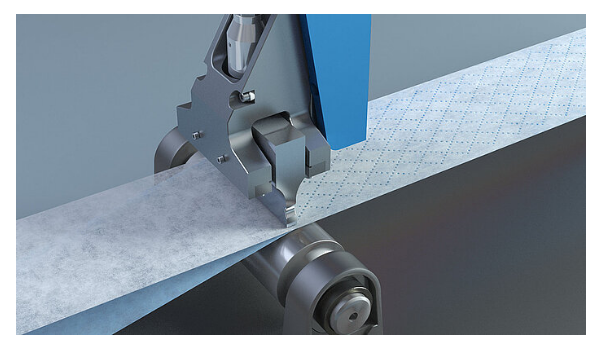
The structure on the rotary anvil means that the nonwovens are only joined in places, unlike the longitudinal seal. This has the advantage that the material properties remain intact thanks to the many targeted connections. For example, the filter function is not affected and the material remains elastic.
Embossing
During embossing, the nonwovens, e.g. cotton pads, have a unique structure pressed into them. This is done by an anvil drum. The special feature when the materials being joined have different colors: The color of the lower track is visible at the weld joint. A design effect, for logos, for example – without additional color printing.

Perforating
Nonwovens can also be perforated in a defined pattern. The material can be perforated gently with ultrasonics and the anvil drum, for instance, in the case of wound dressings and plasters.
Cutting
The ultrasonic tools can even cut. While at the same time, the cut edge is sealed. This is used in the production of single-use gloves, for instance.

Weld geometries
The surface design of the anvil drum, the weld geometry, is designed to follow the individual requirements of the products and weld processes. The energy is focused at the highest point of the anvil drum, and this is where the melting takes place.
This allows the realization of complex applications with user-friendly, very simple handling
This documents extracted from Herrmann website.
Here to Assist You we offer state-of-the-art turnkey solutions for machine of disposable hygiene products. if you want to know more about our products, please feel free to contact us MP/Whatsapp:+86 133 7599 0029 EMAIL:zpmachinery@163.com
|


ICP:1234567890